Football Match Predictor
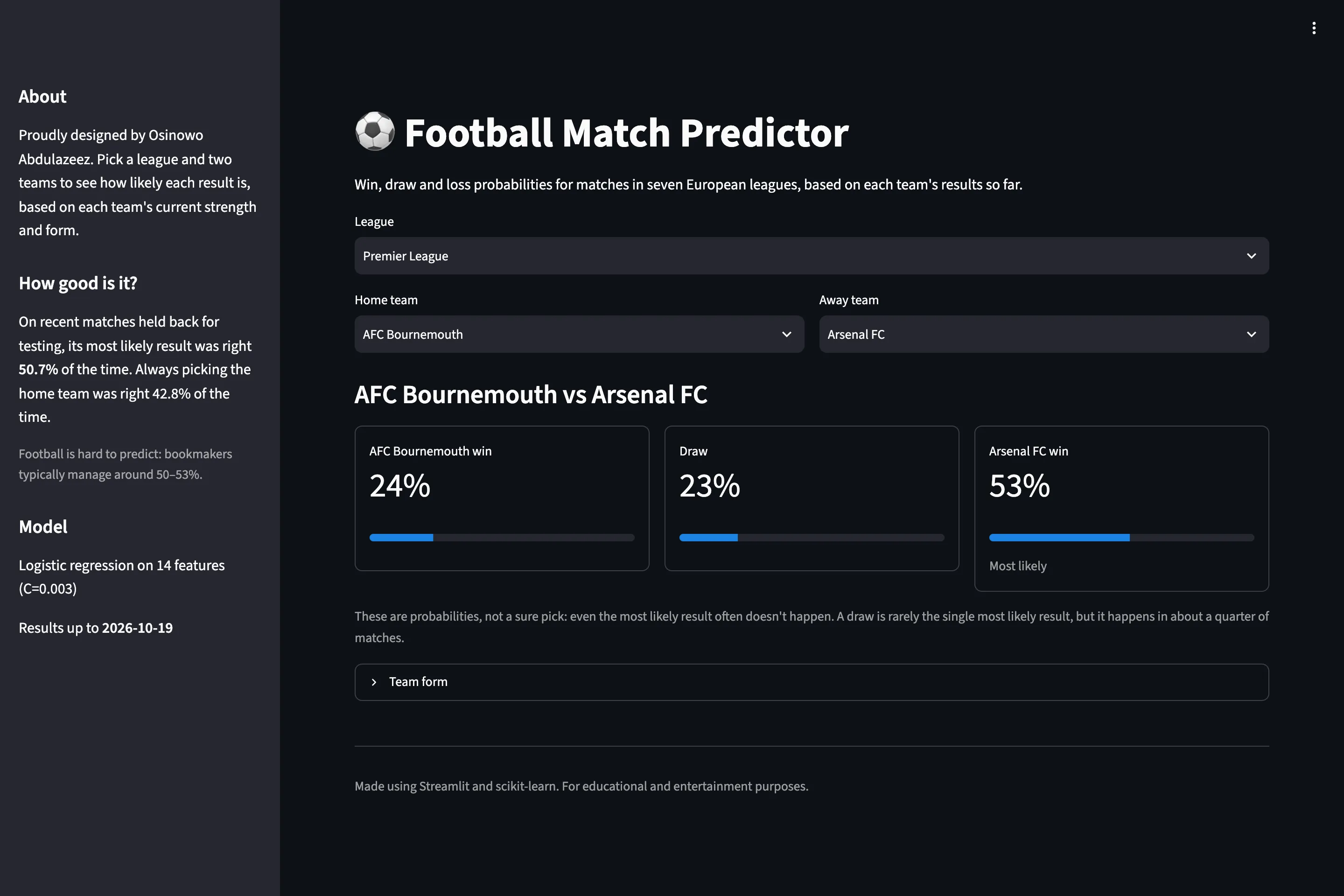
A machine learning model that gives win, draw and loss probabilities for matches in seven European leagues, tested honestly on matches it never saw, and retrained every week.
note: the demo runs on free hosting, so the first load can take up to a minute while the server wakes up.
Results
- Results called correctly on 1,043 unseen matches
- 50.7%
- Better than always picking the home team (42.8%)
- +8 pts
- Log loss, against 1.076 for the baseline (lower is better)
- 0.999
- European leagues covered
- 7
- Matches in the dataset
- 5,215
cat problem.md
The problem
Football predictions online usually come with a confident pick and an impressive accuracy figure that nobody can check. A useful model has to be tested on matches it has never seen, compared against simple baselines, and honest about how hard the problem is. Bookmakers themselves typically get the result right only 50 to 53% of the time.
What we built
A model that predicts Home Win, Draw or Away Win for the Premier League, La Liga, Serie A, Bundesliga, Eredivisie, Ligue 1 and Primeira Liga, shown as probabilities rather than a single pick. A web app lets anyone choose a league and two teams, and a public API returns the same prediction with the numbers behind it.
Each team is described by 14 numbers (7 per team): an Elo strength rating, points and goals per game this season, home or away form, and form over the last five matches. Every number is taken from the team’s state before kick-off, so the model never sees the result it is predicting.
The 71% we withdrew
An earlier version of this project reported 71% accuracy. That figure was wrong: some features included the result of the match being predicted, a bug called data leakage. We found it, rebuilt the features so they are computed match by match in date order, and withdrew the number. The honest figure is 50.7%, in line with what bookmakers achieve.
A model that looks great in testing and fails on real data is worse than no model. Checking for leakage is the first thing we do on any prediction project.
Why the simplest model won
We tested three models on the 1,043 most recent matches (16 March to 19 October 2026), which none of them saw during training or tuning:
| Model | Accuracy | Log loss |
|---|---|---|
| Always predict home win | 42.8% | - |
| Logistic regression (used live) | 50.7% | 0.999 |
| Gradient boosting | 50.7% | 1.009 |
| Neural network (PyTorch) | 48.0% | 1.015 |
The simple model matched or beat the complex ones, so it is the one that runs. It is also small enough to serve from a JSON file with no machine learning libraries installed, which keeps hosting free.
Keeps itself up to date
A scheduled GitHub Actions job pulls the latest results every Tuesday, rebuilds the dataset and retrains the model. The new model goes live after a manual check, so a bad data pull never reaches visitors.
What this means for your business
The same method applies to any “what happens next” question with a history behind it: which leads will buy, which customers are about to leave, how much stock to order. Start with a simple baseline, test on data the model has never seen, and only add complexity when it measurably helps.
cat project.json
- industry:
- Sports analytics
- built:
- October 2026
- stack:
- Pythonpandasscikit-learnPyTorchWeights & BiasesMySQLFastAPIStreamlitGitHub ActionsRender